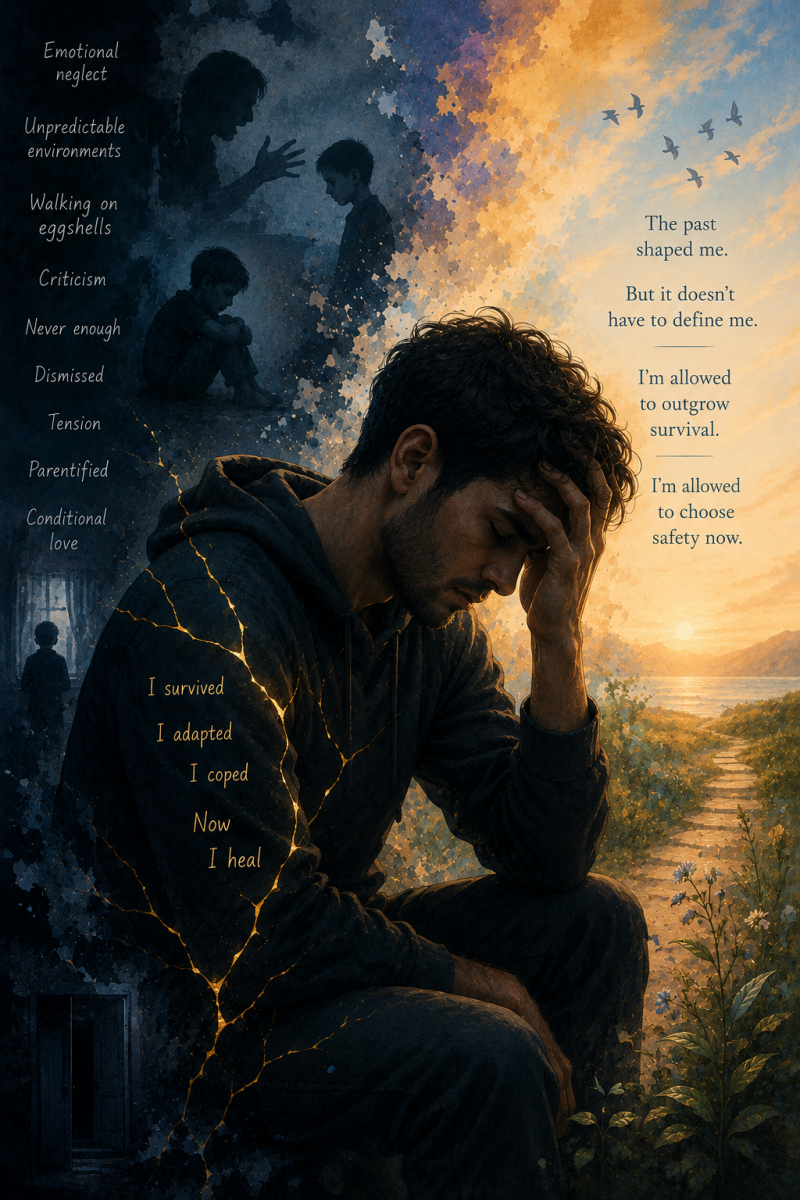
by Francois Martin Hunter
Some people do not realise they were struggling as children because survival became normal to them.
They thought anxiety was personality.
Hyper-independence was maturity.
Emotional suppression was strength.
People-pleasing was kindness.
Overthinking was responsibility.
Being “easy” was something to be proud of.
So they kept going.
They adapted.
Performed.
Achieved.
Stayed quiet.
Stayed useful.
Stayed emotionally controlled.
Learned how to survive environments that did not always feel emotionally safe.
And often, nobody noticed.
Because developmental trauma does not always look dramatic from the outside.
Sometimes it looks like the child who never caused problems.
The child who grew up too quickly.
The child who learned to read the room before speaking.
The child who became emotionally responsible for everyone else.
The child who learned that their feelings took up too much space.
The child who stopped asking for comfort because comfort rarely came consistently.
Some childhood wounds do not appear immediately because children are built to survive.
They adapt in order to maintain attachment.
In order to preserve connection.
In order to feel safe enough to keep going.
A child cannot simply walk away from emotional unpredictability, criticism, neglect, tension, or fear.
So instead, the nervous system adapts around it.
And often, those adaptations are praised.
Being mature.
Being independent.
Being calm.
Being productive.
Being self-sufficient.
Being “no trouble.”
But many survival responses only begin hurting once adulthood arrives.
Because eventually, the body starts carrying what childhood never allowed it to feel.
And suddenly the adult who “held it together” for years begins struggling with things they cannot fully explain.
Anxiety.
Burnout.
Hypervigilance.
Relationship difficulties.
Emotional numbness.
People-pleasing.
Fear of conflict.
Feeling emotionally unsafe even in healthy relationships.
Exhaustion from constantly monitoring other people’s moods.
Feeling guilty for having needs.
Never truly relaxing.
Feeling disconnected from themselves without understanding why.
And often, there is shame attached to this.
Because many people look back at their childhood and think:
“But nothing that bad happened.”
“My parents did their best.”
“I was never abused.”
“Other people had it worse.”
And sometimes that is true.
Developmental trauma is not always about obvious cruelty.
Sometimes it is about growing up in environments where emotional safety, attunement, consistency, comfort, or secure connection were missing often enough that the nervous system adapted around survival instead of safety.
A child can be loved and still feel emotionally unsafe.
A parent can care deeply and still lack the emotional tools to provide attunement, regulation, or consistency.
Trauma is not always about intention.
Sometimes it is about impact.
And honestly, one of the most painful parts of healing developmental trauma is grieving how much of your personality was actually survival.
Realising that:
your hyper-independence was protection.
Your perfectionism was fear.
Your people-pleasing was safety.
Your emotional numbness was adaptation.
Your difficulty trusting people was learned survival.
Your constant alertness was your nervous system trying to protect you.
That grief can feel enormous.
Because healing developmental trauma is not simply “moving on from the past.”
It often involves meeting younger parts of yourself that spent years trying to survive emotionally without the safety, reassurance, or regulation they needed.
And many people become exhausted trying to hate themselves into functioning better.
Trying to shame themselves out of survival responses.
Trying to force themselves to relax.
Trying to become less sensitive.
Less emotional.
Less affected.
Less human.
But healing rarely happens through self-punishment.
Healing often begins when survival responses stop being treated as personal failures and start being understood with compassion.
Not everything your nervous system learned in childhood is still necessary now.
But your body did not learn those patterns for no reason.
It learned them to protect you.
And perhaps part of healing is not asking:
“What is wrong with me?”
But instead:
“What happened to me that taught my nervous system survival mattered more than safety?”
If this resonated with you, counselling can offer a space to gently explore the impact of childhood experiences, attachment wounds, and survival patterns without judgement or shame.
You do not need to have experienced “obvious trauma” to deserve support.
Sometimes the deepest wounds are the ones that were never fully seen.