by Francois Martin Hunter
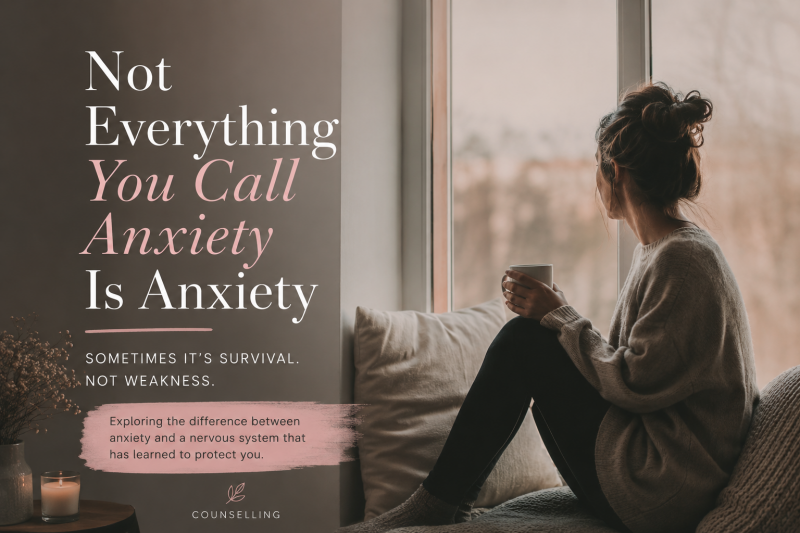
There are people walking around right now calling themselves “anxious” who are, in reality, exhausted from surviving.
Exhausted from scanning.
From anticipating.
From reading every shift in tone.
From preparing for things to go wrong before they happen.
From constantly trying to stay emotionally safe in a world that has not always felt safe to them.
And after a while, all of that gets labelled as anxiety.
But not everything you call anxiety is anxiety.
Sometimes it is hypervigilance.
Sometimes it is emotional survival.
Sometimes it is what happens when your nervous system has spent years learning that safety is unpredictable.
Because when you grow up around criticism, anger, instability, rejection, emotional neglect, bullying, or environments where you had to constantly monitor yourself to feel accepted, your body adapts.
It learns.
It learns to stay alert.
It learns to read the room quickly.
It learns to think ten steps ahead.
It learns to avoid being “too much.”
It learns to notice every facial expression, every silence, every change in energy.
Not because you are dramatic.
Not because you are weak.
But because somewhere along the way, your nervous system learned that missing something could cost you emotionally.
So now you overthink.
You replay conversations.
You worry people are upset with you.
You apologise even when you have done nothing wrong.
You struggle to relax.
You feel guilty for resting.
You feel responsible for other people’s emotions.
You prepare for worst-case scenarios automatically because your body believes preparedness equals protection.
And often, you become incredibly good at functioning.
That is the part many people miss.
Some of the most anxious people are also the most capable.
The most self-aware.
The most emotionally attuned.
The most thoughtful.
The people everyone relies on.
Because survival can make people highly adaptive.
But being adaptive is not the same as feeling safe.
A lot of people do not realise how exhausted they are until they enter a space where they no longer have to perform being okay.
That is often why people cry in therapy after saying “I don’t even know why I’m emotional.”
Because for the first time in a long time, their nervous system is not busy surviving the room.
The difficult thing about living in survival mode is that it eventually starts to feel like your personality.
You think:
“This is just who I am.”
“I’ve always been anxious.”
“I’m just an overthinker.”
“I’m just sensitive.”
But many people who describe themselves this way are carrying nervous systems that have rarely experienced consistent emotional safety.
And that changes the way you move through the world.
It becomes difficult to fully rest because part of you is always waiting for something.
Difficult to trust because part of you expects hurt.
Difficult to stop overthinking because your brain believes vigilance keeps you safe.
This is also why phrases like “just calm down” rarely help.
You cannot shame a nervous system into feeling safe.
You cannot logic yourself out of survival patterns your body learned over years.
You can understand intellectually that you are safe and still feel emotionally braced for impact.
That is not failure.
That is what survival responses often look like.
And underneath all of this, there is often grief.
Grief for how long you have had to carry this.
Grief for how exhausting it has been.
Grief for the version of you that learned safety depended on staying alert, quiet, useful, pleasing, productive, agreeable, or emotionally controlled.
Many people have spent so much of their lives surviving that true rest feels unfamiliar.
Sometimes even unsafe.
Healing is not becoming fearless.
It is not suddenly never overthinking again.
It is not forcing yourself to “just let things go.”
Often, healing begins much smaller than that.
It looks like noticing when your body is bracing.
Pausing before automatically blaming yourself.
Learning that not every silence means rejection.
Allowing yourself to rest without earning it first.
Realising you do not have to stay hyperaware to deserve love, connection, or safety.
And perhaps most importantly, it is slowly teaching your nervous system that it no longer has to survive every moment as if danger is around the corner.
Because sometimes anxiety is not the problem.
Sometimes it is the body doing exactly what it learned to do to survive.
And maybe the question is not:
“What is wrong with me?”
Maybe the question is:
“What happened to me that taught my body the world was not always safe?”
If this resonated with you, and you are tired of carrying the weight of constantly feeling on alert, counselling can offer a space where you do not have to keep surviving everything alone.
You do not need to be in crisis to deserve support.
Sometimes healing begins simply by finally having a space where your nervous system feels safe enough to exhale.Get in touch.